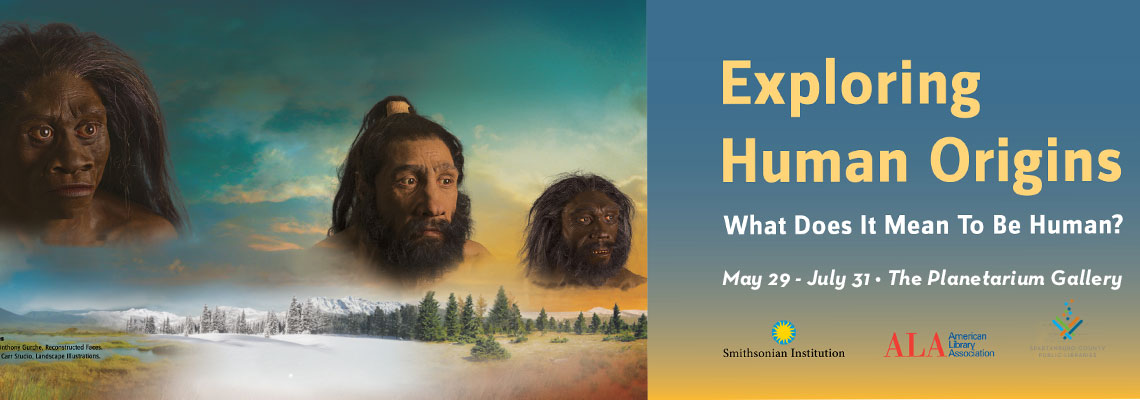
Exploring Human Origins: What Does It Mean To Be Human?
The 1,200-square-foot traveling exhibition includes more than 40 educational panels, interactive kiosks, hands-on displays, videos, 3-D skull casts and presentations representing groundbreaking research in the scientific study of human origins. “Exploring Human Origins: What Does It Mean to Be Human?” will highlight key milestones in the journey of human evolution and explain how they developed over time, including walking upright, the earliest known technologies, brain enlargement, symbolic language development, the origin of agriculture and the creation of complex societies.
The traveling exhibition appeals to the innate curiosity of all human beings in terms of understanding themselves and their own existence. It aims to engage local communities in the global scientific exploration of how humans have evolved over time, while inviting discussion that connects this exploration to varied societal perspectives about what it means to be human.
Exploring Human Origins: Promoting a National Conversation on Human Evolution is administered by ALA's Public Programs Office in collaboration with the Smithsonian National Museum of Natural History's (NMNH) Human Origins Program.
The traveling exhibition will feature replicas and images of specimens from the Smithsonian’s “David H. Koch Hall of Human Origins” in the nation’s capital. More than 20 million people have visited the $20.7 million permanent exhibition hall since it first opened in March 2010. The 15,000-square-foot exhibition space was named for David H. Koch, a well-known philanthropist, whose $15 million gift made the hall possible. Both the permanent and traveling exhibitions are part of the National Museum of Natural History’s Human Origins Initiative, which seeks to explore what it means to be human.
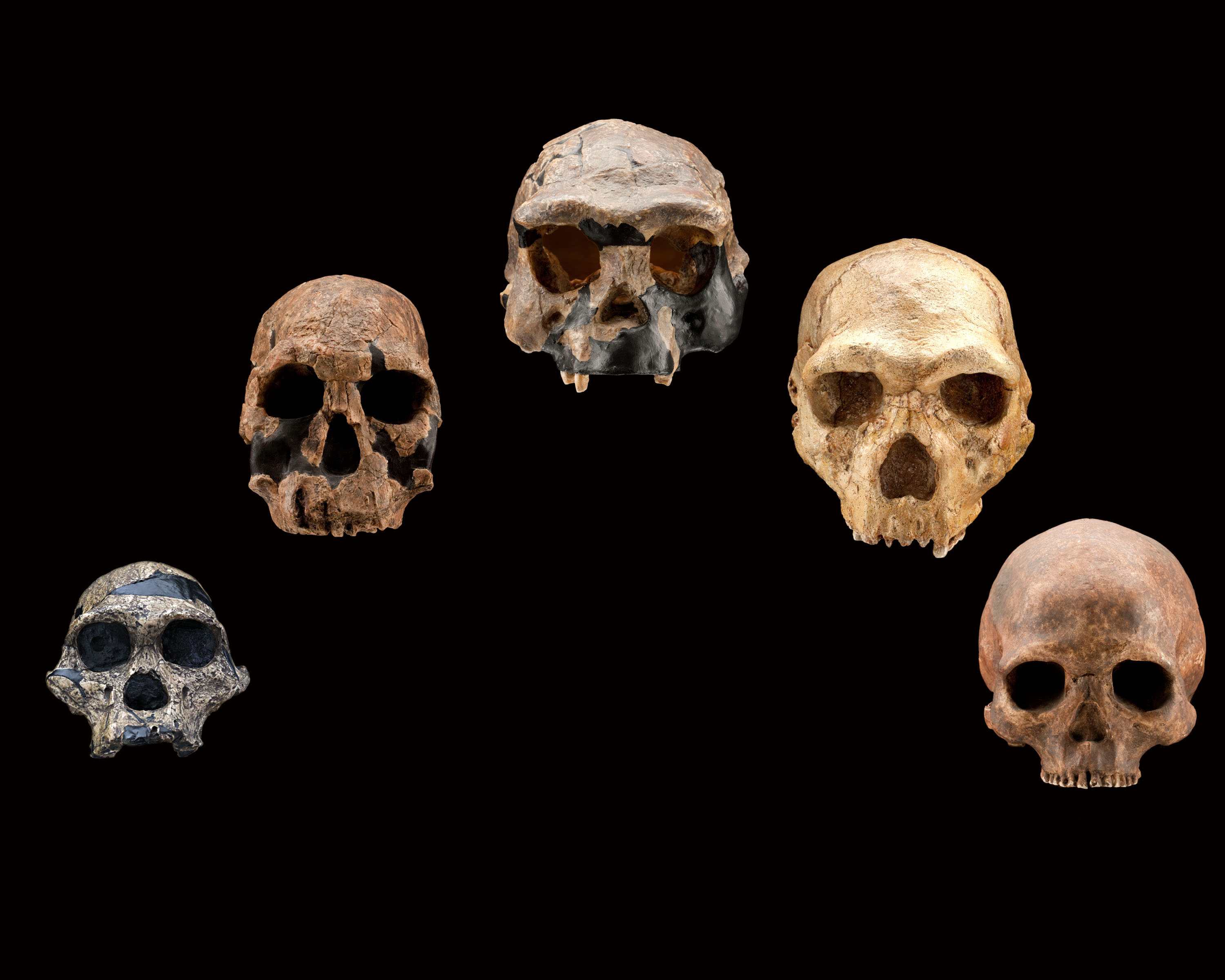
The 1,200-square-foot traveling exhibition includes 3-D skull casts representing groundbreaking research in the scientific study of human origins. Credit: Smithsonian's Human Origins Program

The traveling exhibition will feature replicas and images of specimens from the Smithsonian’s “David H. Koch Hall of Human Origins” in Washington, D.C., including a reproduction of this bronze statue created by John Gurche of a curious two-year old Homo neanderthalensis learning from his mother. Credit: Smithsonian's Hall of Human Origins
Science Talk/Exhibit Opening
Friday, June 5 - 3:00 pm – 5:00 pm
The Planetarium, Headquarters Library
Hosted by Human Origins Program Director and Curator, Dr. Rick Potts.
Dr. Rick Potts is a paleoanthropologist who directs the Human Origins Program at the Smithsonian’s National Museum of Natural History, where he also holds the Peter Buck Chair in Human Origins. Since joining the Smithsonian in 1985, Rick has dedicated his research to piecing together the record of Earth’s environmental change and human adaptation. His ideas on how human evolution responded to environmental instability have stimulated wide attention and new research in several scientific fields.
Bridging across many research disciplines, Rick’s field projects are located in the East African Rift and in southern and northern China. His latest work in the Rift Valley of Kenya has gained international attention as the first project to obtain a long drill core from an early human site in Africa, which will provide a detailed climate record spanning the past 500,000 years. Rick received his Ph.D. in biological anthropology from Harvard University in 1982, after which he taught anthropology at Yale University and served as curator of physical anthropology at the Yale Peabody Museum. Rick is curator of both The David H. Koch Hall of Human Origins at the Smithsonian’s National Museum of Natural History and a new, accompanying traveling exhibition called “Exploring Human Origins: What Does It Mean To Be Human?” He is also the author of the companion book, “What Does It Mean To Be Human?”
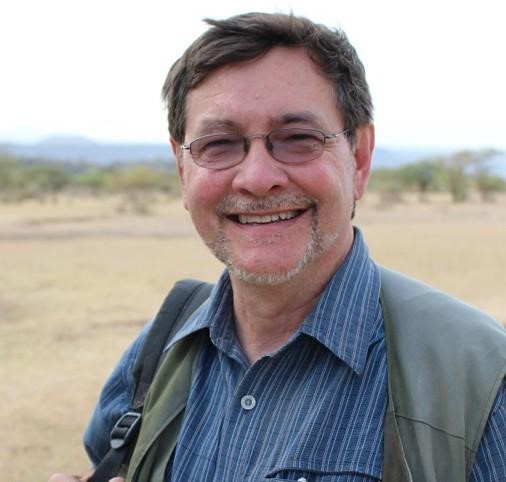
Dr. Rick Potts, Smithsonian's Human Origins Program
Community Conversation
Saturday, June 6 - 2:00 pm – 3:30 pm
The Planetarium, Headquarters Library
Hosted by Human Origins Program Director and Curator, Dr. Rick Potts, paleoanthropologist, Briana Pobiner, retired ordained minister, Jim Miller, and science educator, Lee Meadows.
Briana Pobiner Biography
Briana Pobiner is a paleoanthropologist whose zooarchaeological and taphonomic research centers on the evolution of human diet (with a focus on meat-eating), but has included topics as diverse as human cannibalism and chimpanzee carnivory. Since joining the Smithsonian in 2005 to help put together the Hall of Human Origins, in addition to continuing her active field, laboratory, and experimental research programs, she leads the Human Origins Program’s education and outreach efforts, including managing the Human Origins Program's public programs, website content, social media, and exhibition volunteer training. Briana has more recently developed an additional research program in evolution education and science communication. She is also an Associate Research Professor of Anthropology in the Center for the Advanced Study of Human Paleobiology at the George Washington University.
Jim Miller Biography
Jim Miller is an honorably retired ordained minister in the Presbyterian Church (USA) with an AB in American Studies for the University of Maryland, an MDiv from Union Presbyterian Seminary, and a Ph.D. from Marquette University. Immediately following seminary, he served for five years on the staff of the Department of Engineering Mechanics, North Carolina State University. He has served as an ecumenical campus minister at Michigan Technological University (1975-1981) and the University of Pittsburgh, Carnegie Mellon University, and Chatham College (1984-1996). For nearly ten years he was the Senior Program Associate for the Program of Dialogue on Science, Ethics, and Religion of the American Association for the Advancement of Science (AAAS). He was the founding Secretary/Treasurer and four term past President of the Presbyterian Association on Science, Technology and the Christian Faith. Since 2008 Jim has served as co-chair of the Broader Social Impacts Committee of the Program on Human Origins of the Smithsonian’s National Museum of Natural History. He was elected a Fellow of the American Association for the Advancement of Science in 2020.
Lee Meadows Biography
Lee Meadows, Ph.D., is a science educator based in Birmingham, Alabama. He has written and spoken across his career on the teaching of evolution in the Deep South and is the author of The Missing Link: An Inquiry Based Approach for Teaching Evolution to All Students and co-author of Making Sense of Science and Religion: Strategies for the Classroom and Beyond. A teacher at heart, Lee has taught high school chemistry, physics, and physical science; college chemistry; and many teacher education courses, especially science teaching methods. He guided the launch of Alabama STEM Council as its first Executive Director, focusing the work on building the STEM education system Alabama needs for a thriving workforce. Before that he worked as professor in the School of Education at the University of Alabama at Birmingham, guiding science teachers to improve their practice especially with better skills for inquiry and implementing science and engineering practices.

Briana Pobiner

Jim Miller

Lee Meadows
Additional Library Programs
May 5, 2026 at 4:00pm - Woodruff Library
• Exploring Human Origins: Kids Play: Kids Summer "Olympics"
Kids learn about the origins of the Olympic Games and play outdoor games. Best suited for ages 6-12.
June 16, 2026 at 6:00 pm - Landrum Library
• Exploring Human Origins: Fungal Foundations: How Mushrooms Build the Earth Beneath our Feet
Learn why mushrooms are such an integral part of the ecosystem.
July 7, 2026 at 5:00pm – The Planetarium
• Exploring Human Origins: Catawba 101
Catawba Nation member Kassidy Plyler will join us under the dome to share the history and creation story of the Catawba tribe.
July 13, 2026 at 6pm - Boiling Springs Library
• Exploring Human Origins: Anthropology with Dr. Scott Legge
A paleoanthropologist outlines the current scientific understanding of early humans and human relatives.
July 23, 2026 at 1:30 pm - Middle Tyger Library
• Exploring Human Origins: Building Lava Madness
Learn about the science behind volcanos and the myths and legends tied to these geological wonders while you build your own volcano and create multi-colored eruptions.
July 30, 2026 at 6:00pm – Headquarters Library
• Exploring Human Origins: AI and the Human
When we talk about AI, we often focus on what the technology can do. But the more important question is, what should matter as these systems become part of our lives? The program will begin with a 15-20 minute talk followed by an open discussion, inviting participants to reflect on what we want to preserve, redefine, and prioritize as AI continues to evolve.
Related Exhibits
May 29 – July 31 - at&t exhibition lobby, Headquarters Library
• “Human Landscapes: Spartanburg County in the Anthropocene” - Humans have inhabited and shaped the lands of the Carolina Piedmont for well over 10,000 years. Different methods of landscape management and shifting population sizes have wrought tremendous changes in that time. This exhibit explores the evolution of Spartanburg County’s landscape under human occupation in conjunction with the Exploring Human Origins exhibit.
June 1st - July 31st - Companion Exhibit
• Cyrill - Westside Library will host a local history exhibit looking at the evolution of place here in Spartanburg County as a part of a Local History exhibit and how humans have impacted Spartanburg County through history.